Formal learning takes place in educational and training institutions and leads to recognized diplomas or qualifications.
Below is a selection of organizations I have worked with in formal learning contexts.

I think first about how people move. How they enter a space, where they slow down, what draws them in, and where they choose to linger or move on. Learning unfolds through that movement. It is shaped by pace, sequence, and choice, not just by content.
It is rare to have the opportunity to begin from a clean slate. Most exhibit work happens within constraints, existing narratives, or inherited structures of the collaborative roles. Whether conceptualizing or augmenting a space, the learning journey can be intentionally shaped by space, flow, and interaction.
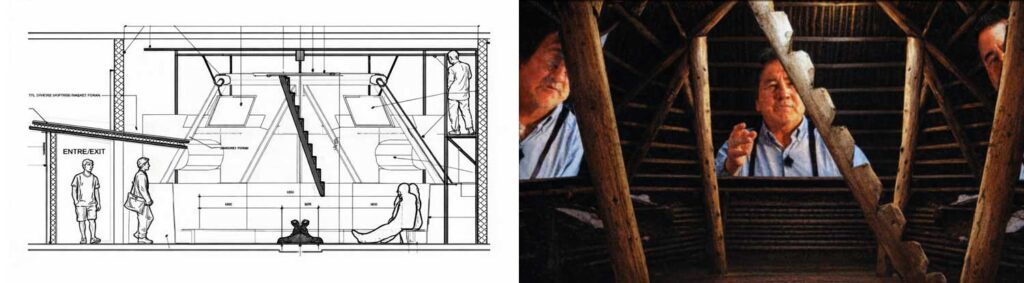
We designed the video experience for the Ancestors’ Voices Pithouse exhibit at the Nk’mip Desert Cultural Centre, working in collaboration with Aldrich Pears and Associates.
Early designs used small video panels. We proposed rethinking the hardware and concealing it behind a scrim so the video could expand across the interior of the pithouse. This allowed moving imagery to wrap the space, creating a sense of motion, time, and presence rather than a fixed screen.
The story of Sen’klip, the Coyote Trickster, became a narrative layer within the space, supporting an immersive experience where movement, story, and environment worked together to support learning through presence rather than explanation.
My work focuses on how physical movement becomes a learning structure. Information is layered onto that experience rather than placed on top of it. Messages reveal themselves as people move, encounter objects, and engage with interactive media. Each layer builds on the last, allowing meaning to emerge gradually.
I design interpretive systems that integrate spatial design, artifacts, and interactive media. Objects invite curiosity. Media makes invisible processes visible. Interaction allows people to test ideas and form their own connections. Learning happens through engagement, not instruction.
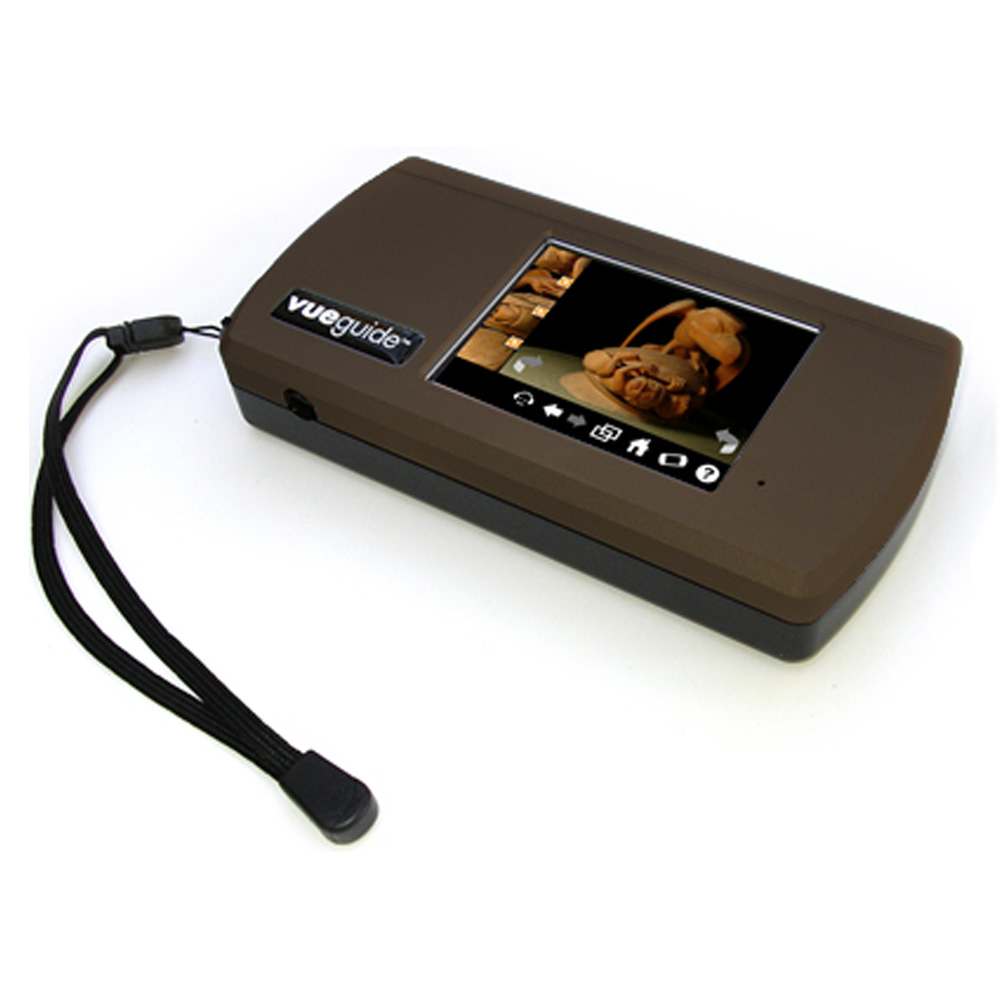
Thinking about how we move through an exhibit space populated with artifacts, some monumental and others tiny, led to the development of the Vueguide.
The first major installation was at the Museum of Anthropology at UBC. We designed a custom handheld multimedia guide using Pocket PC devices and touchscreen interaction. The system relied on custom-manufactured infrared beacons installed throughout the gallery, allowing the guide to respond dynamically to a visitor’s position in space.
In the rotunda, the guide was paired with Raven Discovering the First Men by Bill Reid. As visitors walked around the sculpture, the on-screen raven rotated in real time to match their physical viewpoint. Movement through space became part of the learning experience.
Visitors could select specific details on the sculpture and hear commentary from Bill McLennan, who worked closely with Reid during the carving. Stories, symbolism, and form were revealed through motion, perspective, and voice, layered directly onto the act of looking.
Learning emerged through walking, choosing, and listening.
My work sits at the intersection of exhibit design, interactive media, and learning systems. This includes both cultural and educational projects and my marketing and advertising work in agency settings. Across museums, workplaces, and educational institutions, I design experiences that support learning in different contexts and at different levels of structure. These contexts are often described as informal, non-formal, and formal learning, each with distinct needs, constraints, and opportunities.
Museums, science centres, zoos, aquaria, expos, and outdoor exhibits are places where learning happens informally. People choose what to engage with, how long to stay, and how deeply to explore.This kind of learning values exploration over instruction. It supports personal sense-making rather than prescribed outcomes.
Below is a selection of informal learning organizations I have worked with in this space.
Non-formal learning sits between formal education and informal learning. It usually takes place in structured environments such as workplaces, conferences, or professional settings, without the rigidity of a classroom or degree program. As organizations grow and change, they need ways to orient, train, and align people. This includes employees, partners, and customers.
Below is a selection of organizations I have worked with in non-formal learning contexts.
Formal learning takes place in educational and training institutions and leads to recognized diplomas or qualifications.
Below is a selection of organizations I have worked with in formal learning contexts.

Five years as a curriculum developer, instructor, project supervisor, and mentor at the Vancouver Film School’s Foundation Visual Art & Design Program.

Four years on the Vancouver Community College Program Advisory Board for Multimedia and Digital Design Programs.

BCIT: New Media Design & Web Development, Program Advisory Committee
Three years, BCIT: Computer Systems Technology program, Industry Sponsored Student Projects mentor